 Sir Gawain and the Green Knight, written by an anonymous author some time during the fourteenth century, reflects many of the religious, political and social aspects illustrated in other literary works of the time. The author, a contemporary of Chaucer, lived during a time when gallantry, loyalty and honor defined a true man. During this period, Christianity was prevalent, and inherent human weakness was commonly accepted.
The author begins the poem with the mention of the siege and destruction of Troy, said to be a result of the traitorous acts of the "knight that had knotted the nets of deceit" (Norton 3), Aeneas. The knights who survive this destruction go on to build the great empires of that time:
Great Romulus to Rome repairs in haste; / With boast and with bravery builds he that city / And names it with his own name, that it now bears. / Ticius to Tuscany, and towers raises, / Langobard in Lombardy lays out homes / And far over the French Sea, Felix Brutus / On many broad hills and high Britain he sets, / most fair (8 - 15).
The author focuses on Britain, and the worthy knights bred here, saying: "Bold boys bred there, in broils delighting, / That did in their day many a deed most dire / More marvels have happened in this merry land / Than in any other I know, since that olden time" (21 - 24). Sir Gawain and the Green Knight is just one of many stories surrounding these "bold boys" from the original land of the Arthurian legends.
"The story is set in Camelot, the court of the legendary King Arthur and his knights of the Round Table, during an extraordinary Christmas celebration. The court is relatively new, and the nobles of the land are still young. During this celebration, a strange, supernatural knight boldly interrupts the festivities to challenge the proud court to a beheading game. Proving his loyalty to the king, and living up to the honor code of a knight, young Sir Gawain accepts the challenge. After beheading the Green Knight, who astonishes everyone by remaining alive, Sir Gawain is led on a journey assumed to end in his certain death. During his adventure, his honor and pride are unsuspectingly put to the test, and his human vulnerabilities are pushed to their limits. After three days of feasting, fighting off the sexual advances of a beautiful married woman, and battling with his own weaknesses, Sir Gawain meets the Green Knight, as he has promised, and is ready to die like a true knight. Only then is Gawain told that this game has not been a test of his bravery as a knight, but rather a test of his moral character as a man. With his almost impeccably honorable actions of the past three days, he has already won his life.
In this passage, lines 1 - 59, we are introduced to the court of King Arthur. Emphasis is placed on the happiness and joy experienced by all during the fifteen-day Christmas celebration, hosted by King Arthur. "High were their hearts in halls and chambers, / These lords and these ladies, for life was sweet. / In peerless pleasures passed they their days" (48 - 50), says the narrator. King Arthur, and his people, are young and carefree, enjoying feasting and dancing. The bravery of the knights is emphasized by the many tournaments and jousts taking place, in which all "true men" participate. The participants in the festival are said to be "the most noble knights known under Christ, / And the loveliest ladies that lived on earth ever" (51-52).
The poem ends as it begins, with a reference to the fall of Troy and references to the legendary founder of Britain, Brutus. The author seems to hint to the historical authenticity of the story, saying the "books of Brutus’ deeds bear witness" (2523) to the tale. However, as is true of many other works of the time, the authenticity of the story is very much open to speculation.
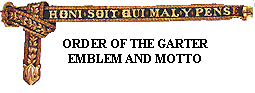
It is difficult to say, definitively, what life was like in "the old days of Arthur," or even to know if there ever actually was such an ideal king. The idea that the audience of the story may have believed it to be a true story, is illustrated by the last line of the poem: "Hony Soyt Qui Mal Pense" (2531). It is believed that this line was included by a copyist, rather than the original author, in an attempt to associate the story to the founding of the "Order of the Garter." This noble British order of knighthood, still in existence today, was established in 1348 by King Edward III. Legend has it that, during a Court ball, Edward was dancing with a lady, (possibly the Countess of Salisbury,) when she lost one of her garters. Edward bent down to pick it up, as any gallant knight would do, and the subjects of the ball were humored by the lady’s obvious embarrassment. Hearing the laughter, he said "Hony soyt qui mal pense," which is translated to mean "shame be to the man who has evil in his mind." The scene in Sir Gawain and the Green Knight, where King Arthur declares the green belt,
given to Gawain by lady Bercilak, to be a symbol of knightly honor, could very well be related to this real-life knightly order.
It is reasonable to assume that the audiences of this time period were familiar with the values and concepts presented in this story of Sir Gawain, and other similar stories. Concepts such as the nobility, gallantry and honor of the knights, the importance of high moral character and faith in Christ as redeemer of an imperfect humankind seem to be emphasized throughout the literary works of this century. The religious and moral values are summed up by the final lines of the poem: "May He that was crowned with thorn / Bring all men to His bliss! Amen. / Hony Soyt Qui Mal Pense" 2524 - 2531). "Shame be to the man who has evil in his mind," might very well be the lesson the author wanted to relay to his or her audience.
Comments to the author are welcomed! Mark Young
Works Cited
"THE CHURCHILL SOCIETY LONDON." The Most Noble Order of the Garter. Online. Internet. 20 November, 2000. Available
http://www.churchill-society-london.org.uk/garter.html
Sir Gawain and the Green Knight. The Norton Anthology of English Literature. Seventh Edition. Volume 1. New York: 2000.
Zhong, Vivian. "Sir Gawain and the Green Knight." Online. Internet. 20 November, 2000. Available
http://csis.pace.edu/grendel/projs993d/main.htm
Images
Background Image with Permission of Jim Heilchuck