


Trading Efficiency for Quality
To overcome this, we may try a more generous neighborhood, for instance 3-change,
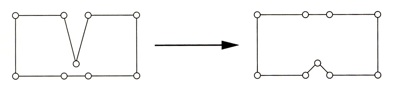
consisting of tours that differ on up to three edges. And indeed, the preceding bad
case gets fixed:
 But there is a downside, in that the size of a neighborhood becomes O (n3),
making each iteration more expensive. Moreover, there may still be suboptimal local
minima, although fewer than before. To avoid these, we would have to go up to
4-change, or higher.
In this manner, efficiency and quality often turn out to be
competing considerations in a local search. Efficiency demands neighborhoods that
can be searched quickly, but smaller neighborhoods can increase the abundance of
low-quality local optima. The appropriate compromise is typically determined by
experimentation.
But there is a downside, in that the size of a neighborhood becomes O (n3),
making each iteration more expensive. Moreover, there may still be suboptimal local
minima, although fewer than before. To avoid these, we would have to go up to
4-change, or higher.
In this manner, efficiency and quality often turn out to be
competing considerations in a local search. Efficiency demands neighborhoods that
can be searched quickly, but smaller neighborhoods can increase the abundance of
low-quality local optima. The appropriate compromise is typically determined by
experimentation.