Approaches to Agent Design (continued)
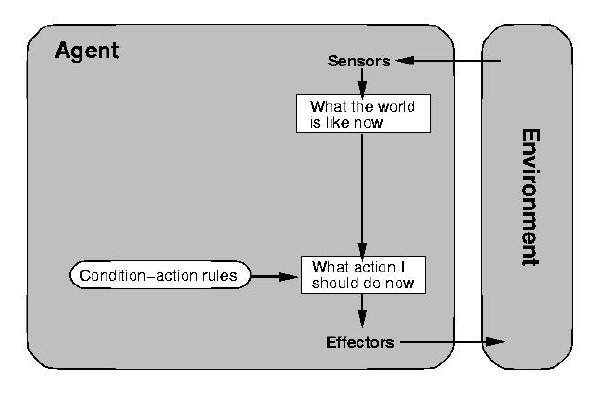
- Reflex Agent with Internal State
- Encode "internal state" of the world to remember the past
as contained in earlier percepts
- Needed because sensors do not usually give the entire
state of the world at each input, so perception of the environment
is captured over time. "State" used to encode different
"world states" that generate the same immediate percept.
- Requires ability to represent change in the world; one
possibility is to represent just the latest state, but then can't
reason about hypothetical courses of action
- Example: Rodney Brooks's Subsumption Architecture
Main idea: build complex, intelligent robots by decomposing behaviors
into a hierarchy of skills, each completely defining a complete
percept-action cycle for one very specific task. For example, avoiding
contact, wandering, exploring, recognizing doorways, etc. Each
behavior is modeled by a finite-state machine with a few states
(though each state may correspond to a complex function or module).
Behaviors are loosely-coupled, asynchronous interactions.