


Artificial Intelligence and Bridge
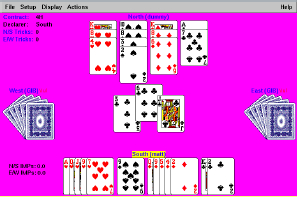
Contract bridge is a partnership game with hidden information and restricted communication. A player must reason simultaneously about cards, opponents, a partner's intentions, and the meaning of earlier bids and plays.
What makes bridge unusual?
| Feature | Consequence for AI |
|---|---|
| Four players in two partnerships | Utilities are shared with a partner, but decisions are decentralized |
| Hidden hands | The true state is not directly observable |
| Bidding conventions | Actions communicate constrained information |
| Sequential card play | Every card reveals evidence about the remaining deal |
| Duplicate scoring | Quality is assessed relative to other players facing the same deal |
Two related AI problems
1. Bidding
Partners use legal bids to choose a contract and convey information. A bidding agent needs a model of conventions, uncertainty, partnership compatibility, and expected contract value. The same bid can have different meanings under different agreed systems.
2. Card play
During play, the agent knows its own cards and the visible dummy hand but not both opponents' hands. It updates beliefs from the auction, cards already played, legal-play constraints, and strategic choices.
Reasoning with possible deals
- Construct a belief distribution over card deals consistent with observed evidence.
- Sample representative deals.
- Evaluate candidate actions across those deals.
- Update beliefs after each bid or card.
A simple system may treat each sampled deal as if all cards were visible and solve it by double-dummy search. This is useful but imperfect: the best action for many fully known deals may be poor when the player must use one action without knowing which deal is real. This error is called strategy fusion.
Modern bridge AI
In March 2022, a NukkAI system outperformed eight bridge world champions in a controlled individual-play challenge. The challenge highlighted bridge as a problem involving incomplete information, sequential reasoning, and explainable decisions. See the NukkAI Bridge Challenge.
This result should be interpreted carefully: it did not solve unrestricted partnership bridge. It tested a controlled form of play designed to compare the AI and champions on common deals.
Useful techniques
- constraint propagation over possible hands;
- Bayesian or learned belief models;
- double-dummy search as a component;
- Monte Carlo sampling of deals;
- policy and value learning from expert records or self-play;
- explicit representations of bidding conventions and explanations.
Connection to intelligent agents
Bridge is a compact example of mental-model reasoning. A strong agent maintains predictions about hidden cards, partner knowledge, opponent knowledge, and how each action changes those beliefs.