select appropriate software engineering tasks
·
Most software
organizations encounter the following projects:
- Concept development projects - initiated to explore some new business concept
or application of some new technology.
- New application development projects - undertaken as a consequence of a specific
customer request.
- Application enhancement projects - occur when existing software undergoes major
modifications to function, performance, or interfaces that are observable
by the end-user.
- Application maintenance projects - correct, adapt, or extend existing software in
ways that may not be immediately obvious to the end-user.
- Reengineering projects - undertaken with the intent of rebuilding an
existing (legacy) system in whole or in part.
·
Degree of
rigor is a function of many project characteristics.
Four
different degrees of rigor can be defined:
- Casual. All process framework activities are applied, but only a minimum
task set is required. In general, umbrella tasks will be minimized and
documentation requirements will be reduced. All basic principles of
software engineering are still applicable.
- Structured. The process framework will be applied for this project. Framework
activities and related tasks appropriate to the project type will be
applied and umbrella activities necessary to ensure high quality will be
applied. SQA, SCM, documentation, and measurement tasks will be conducted
in a streamlined manner.
- Strict. The full process will be applied for this project with a degree of
discipline that will ensure high quality. All umbrella activities will be
applied and robust work products will be produced.
- Quick reaction. The process framework will be applied for this
project, but because of an emergency situation only those tasks essential
to maintaining good quality will be applied. "Back-filling"
(i.e., developing a complete set of documentation, conducting additional
reviews) will be accomplished after the application/product is delivered
to the customer.
·
Project manager must
develop a systematic approach for selecting the degree of rigor that is
appropriate for a particular project.
·
To accomplish this, project
adaptation criteria are defined and a task set selector value is computed
·
Adaptation criteria are used to determine the recommended degree of
rigor with which the software process should be applied on a project. Eleven adaptation
criteria are defined for software
projects:
- Size of the project
- Number of potential users
- Mission criticality
- Application longevity
- Stability of requirements
- Ease of customer/developer communication
- Maturity of applicable technology
- Performance constraints
- Embedded and nonembedded characteristics
- Project staff
- Reengineering factors
·
Each adaptation
criterion is assigned a grade that ranges between 1 and 5
- 1
represents a project in which a small subset of process tasks are
required and overall methodological and documentation requirements are
minimal
- 5
represents a project in which a complete set of process tasks should be
applied and overall methodological and documentation requirements are
substantial
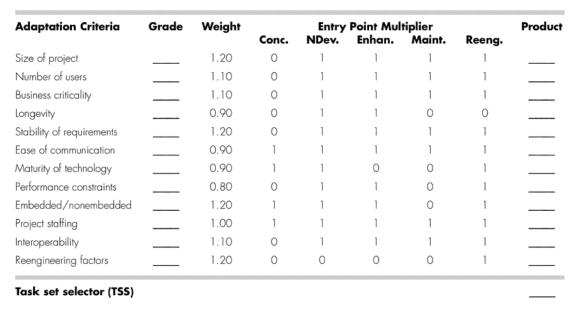
Task Selector Table
·
To select the
appropriate task set for a project, the following steps should be conducted:
- Review each of the adaptation criteria and
assign the appropriate grades (1 to 5) based on the characteristics of the
project.
o
Enter grade into table.
- Review the weighting factors assigned to each of
the criteria.
o
Value of a weighting
factor ranges from 0.8 to 1.2 and provides an indication of the relative
importance of a particular adaptation criterion to the types of software
developed within the local environment.
- Multiply the grade entered in table by the weighting
factor and by the entry point multiplier
for the type of project to be undertaken.
o
Entry point multiplier
takes on a value of 0 or 1 and indicates the relevance of the adaptation
criterion to the project type.
o
Result of the product
grade x weighting factor x entry point multiplier
o
Placed in the Product
column of table for each adaptation criteria individually.
- Compute the average of all entries in the
Product column and place the result in the space marked task set
selector (TSS).
·
This value will be used
to help select the task set that is most appropriate for the project.
·
Interpreting the TSS
Value and Selecting the Task Set
·
Once the task set selector
is computed, the following guidelines can be used to select the appropriate
task set for a project:
| Task set selector value |
Degree of rigor |
| TSS < 1.2 |
casual |
| 1.0 < TSS < 3.0 |
structured |
| TSS > 2.4 |
strict |
·
Overlap in TSS values
from one recommended task set to another is intended to illustrate that sharp
boundaries are impossible to define when making task set selections.
·
The task set selector
value, past experience, and common sense must all be factored into the choice
of the task set for a project.
·
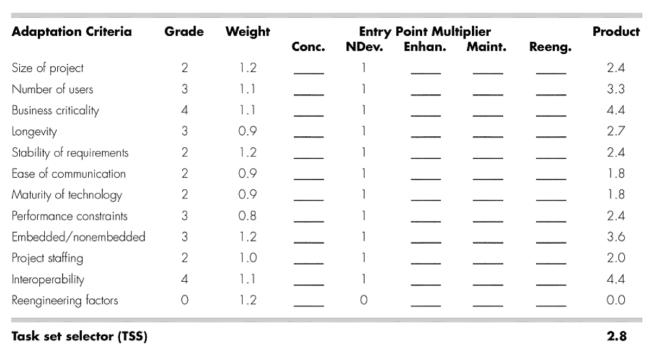
Table illustrates how
TSS might be computed for a hypothetical project.
o
Project manager selects
the grades shown in the Grade column.
o
Project type is new
application development.
o
Therefore, entry point
multipliers are selected from the NDev column. T
o
he entry in the Product
column is computed using
Grade
x Weight x
NewDev entry point multiplier
·
Value of TSS (computed
as the average of all entries in the product column) is 2.8.
·
The manager has the
option of using either the structured or the strict task set.
Selecting
Software Engineering Tasks
·
Development projects
are approached by applying the following major tasks:
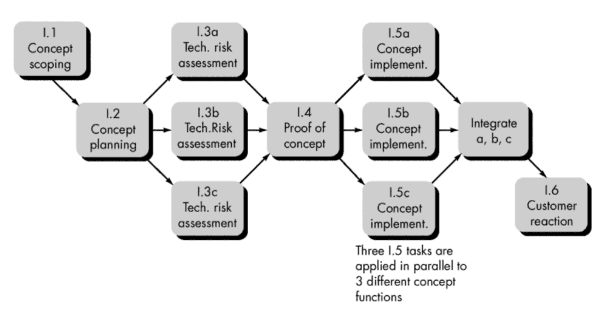
1. Concept scoping determines the overall scope of the project.
2. Preliminary concept planning establishes the organization's ability to undertake
the work implied by the project scope.
3. Technology risk assessment evaluates the risk associated with the technology to
be implemented as part of project scope.
4. Proof of concept demonstrates the viability of a new technology in the software context.
5. Concept implementation implements the concept representation in a manner
that can be reviewed by a customer and is used for "marketing"
purposes when a concept must be sold to other customers or management.
6. Customer reaction to the concept solicits feedback on a new technology concept and
targets specific customer applications.
·
Development framework
activities are iterative in nature.
·
Actual development
project might approach these activities in a number of planned increments, each
designed to produce a deliverable that can be evaluated by the customer.
·
Model Selection:
o
Linear process model
o
Evolutionary model
Refinement
of Major Tasks
·
Major tasks may be used
to define a macroscopic schedule for a project.
·
Macroscopic schedule
must be refined to create a detailed project schedule.
·
Refinement begins by
taking each major task and decomposing it into a set of subtasks (with related
work products and milestones).
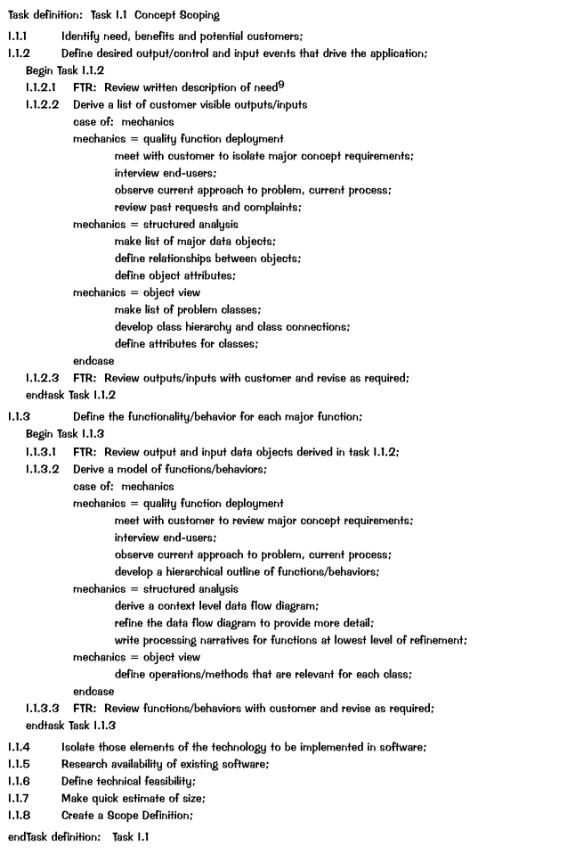
Example of task
decomposition - concept
scoping for a development project:
Defining
a Task Network
·
Individual tasks and
subtasks have interdependencies based on their sequence.
·
It is likely that
development activities and tasks will be performed in parallel.
·
Concurrent tasks must
be coordinated so that they will be complete when later tasks require their
work product(s).
·
Task network ( activity network ) is a
graphic representation of the task flow for a project.
o The task network depicts major software engineering
tasks.
·
Parallel tasks occur
asynchronously
o Planner must determine intertask dependencies to
ensure continuous progress toward completion.
o
Project manager should
be aware of those tasks that must be completed on schedule if the project as a
whole is to be completed on schedule.
Scheduling
·
Generalized project
scheduling tools and techniques can be applied with little modification to
software projects.
·
Program evaluation
and review technique (PERT) and critical
path method (CPM) are two project scheduling methods that can be applied to
software development.
·
Both techniques are
driven by information already developed in earlier project planning activities:
o
Estimates of effort
o
A decomposition of the
product function
o
The selection of the
appropriate process model and task set
o
Decomposition of tasks
·
Interdependencies among
tasks may be defined using a task network.
·
Tasks (work
breakdown structure (WBS)) are defined for the product as a whole or for
individual functions.
·
PERT and CPM provide
quantitative tools that allow the software planner to
- determine the critical path—the chain of
tasks that determines the duration of the project
- establish "most likely" time estimates
for individual tasks by applying statistical models
- calculate "boundary times" that define
a time "window" for a particular task.
·
Important boundary
times discerned from a PERT or CPM network:
1. the earliest time that a task can begin when all
preceding tasks are completed in the shortest possible time
2. the latest time for task initiation before the
minimum project completion time is delayed
3. the earliest finish—the sum of the earliest start and
the task duration
4. the latest finish—the latest start time added to task
duration
5. the total float—the amount of surplus time or
leeway allowed in scheduling tasks so that the network critical path is
maintained on schedule.
·
Boundary time
calculations lead to a determination of critical path and provide the manager
with a quantitative method for evaluating progress as tasks are completed.
·
PERT and CPM
implemented in a variety of automated tools that are available for the personal
computer
·
Such tools are easy to
use and make the scheduling methods described previously available to every
software project manager
Timeline Charts
·
Software project
schedule - planner begins with a set of tasks
·
Effort, duration, and
start date are input for each task.
·
Tasks may be assigned
to specific individuals.
·
Timeline chart, ( Gantt
chart) generated.:
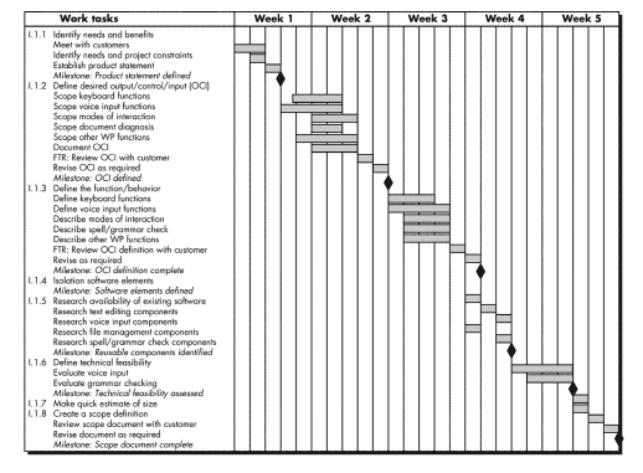
- Depicts a part of a software project schedule
that emphasizes the task for a new word-processing (WP) software product.
- All project tasks are listed in the left-hand
column.
- Horizontal bars indicate the duration of each
task.
- When multiple bars occur at the same time on the
calendar, task concurrency is implied. The diamonds indicate milestones.
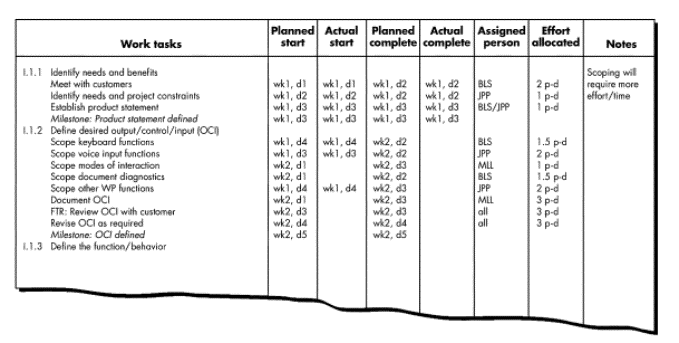
- Software project scheduling tools produce project
tables—a tabular listing of all:
- project tasks
- their planned and actual start- and end-dates,
- variety of related information
- Used in conjunction with the timeline chart,
project tables enable the project manager to track progress.
Tracking the Schedule
·
The project schedule
provides a road map for a software project manager.·
Project schedule defines
the tasks and milestones that must be tracked and controlled as the project
proceeds. ·
Tracking can be
accomplished in a number of different ways:
o
Conducting periodic
project status meetings in which each team member reports progress and
problems.
o
Evaluating the results
of all reviews conducted throughout the software engineering process.
o
Determining whether
formal project milestones have been accomplished by the scheduled date.
o
Comparing actual
start-date to planned start-date for each project task listed in the resource
table
o
Meeting informally with
practitioners to obtain their subjective assessment of progress to date and
problems on the horizon.
·
Time-boxing strategy recognizes that the complete product may not
be deliverable by the predefined deadline.
o
An incremental software
paradigm is chosen and a schedule is derived for each incremental delivery.
o
Tasks associated with
each increment are time-boxed.
o
The schedule for each
task is adjusted by working backward from the delivery date for the increment.
o
A "box" is
put around each task.
o
When a task hits the
boundary of its time box (plus or minus 10 percent), work stops and the next
task begins.
Earned
Value Analysis
·
Earned value
analysis (EVA) - qualitative approaches to project tracking
o
Provides a common value
scale for every software project task, regardless of the type of work being
performed.
o The total hours to do the whole project are
estimated, and every task is given an earned value based on its estimated
percentage of the total.
·
Earned value is a
measure of progress
o
Able to assess the
"percent of completeness" of a project using quantitative analysis
Following steps
performed:
1. The budgeted cost of work scheduled (BCWS) is
determined for each work task represented in the schedule.
1. The work (in person-hours or person-days) of each
software engineering task is planned.
2. BCWSi is
the effort planned for work task i.
3. To determine progress at a given point along the
project schedule, the value of BCWS is the sum of the BCWSi
values for all work tasks that should have been completed by that
point in time on the project schedule.
2. The BCWS values for all work tasks are summed to
derive the budget at completion, BAC. Hence,
BAC
= S (BCWSk) for all tasks k
3. Next, the value for budgeted cost of work
performed (BCWP) is computed.
1. The value for BCWP is the sum of the BCWS values for
all work tasks that have actually been completed by a point in time on the
project schedule.
·
The distinction between
BCWS and BCWP is that the former represents the budget of the activities that
were planned to be completed and the latter represents the budget of the
activities that actually were completed.·
Given values for BCWS, BAC,
and BCWP, progress indicators can be computed:
Schedule performance index, SPI =
BCWP/BCWS Schedule
variance, SV = BCWP - BCWS
·
SPI is an indication of the
efficiency with which the project is utilizing scheduled resources. o
An SPI value close to 1.0
indicates efficient execution of the project schedule.·
SV is an absolute
indication of variance from the planned schedule.
·
Percent scheduled for
completion = BCWS/BACo
provides an indication of
the percentage of work that should have been completed by time t.·
Percent complete = BCWP/BAC
o
provides a quantitative
indication of the percent of completeness of the project at a given point in
time, t.
·
Actual cost of work
performed, ACWP - the sum of the
effort expended on work tasks that have been completed by a point in time on
the project schedule.
o It is then possible to compute
Cost
performance index, CPI = BCWP/ACWP
Cost variance, CV = BCWP - ACWP
o
CPI close to 1.0
provides a strong indication that the project is within its defined budget.
o
CV is an absolute
indication of cost savings (against planned costs) or shortfall at a particular
stage of a project.
Error
Tracking
·
Throughout the software
process, a project team errors associated with each work product.
·
Error-related measures
and resultant metrics are collected over many software projects, can be used as
a baseline for comparison against error data collected in real time.
·
Error tracking can be
used as one means for assessing the status of a current project.
Defect removal efficiency
·
Software team performs
formal technical reviews (and, later, testing) to find and correct errors, E,
in work products produced during software engineering tasks.
·
Any errors that are not
uncovered (but found in later tasks) are defects, D.
·
Defect removal
efficiency is defined as
DRE
= E/(E + D)
·
DRE is a process metric
that provides a strong indication of the effectiveness of quality assurance
activities
·
DRE can also be used to
assist a project manager in determining the progress that is being made as a
software project moves through its scheduled work tasks.
o
e.g. a software
organization has collected error and defect data over the past 24 months and
has developed averages for the following metrics:
§
Errors per requirements
specification page, Ereq
§
Errors per
component—design level, Edesign
§
Errors per
component—code level, Ecode
§
DRE—requirements
analysis
§
DRE—architectural
design
§
DRE—component level
design
§
DRE—coding
·
As the project
progresses through each software engineering step, the software team records
and reports the number of errors found during requirements, design, and code
reviews.
·
The project manager
calculates current values for Ereq, Edesign,
and Ecode.
·
Compared to averages
for past projects.
·
If current results vary
by more than 20% from the average, there may be cause for concern and there is
certainly cause for investigation.
·
For example, if Ereq
= 2.1 for project X, yet the organizational average is 3.6, one of two
scenarios is possible:
- the software team has done an outstanding job of
developing the requirements specification or
- the team has been lax in its review approach. If
the second scenario appears likely, the project manager should take
immediate steps to build additional design time into the schedule to
accommodate the requirements defects that have likely been propagated into
the design activity.
The
Project Plan
·
Each step in the
software engineering process should produce a deliverable that can be reviewed
and that can act as a foundation for the steps that follow.
·
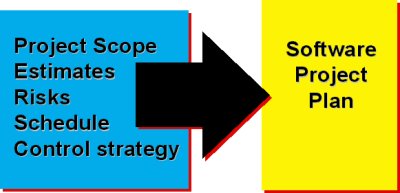
The Software Project
Plan is produced at the culmination of the planning tasks.
·
It provides baseline
cost and scheduling information that will be used throughout the software
process.
·
The Software
Project Plan must
1. communicate scope and resources to software
management, technical staff, and the customer
2. define risks and suggest risk aversion techniques
3. define cost and schedule for management review
4. provide an overall approach to software development
for all people associated with the project
5. outline how quality will be ensured and change will
be managed.