CS615 – Software Engineering I
|
|
Lecture 8 |
Chapter 18: Software Testing Strategies
Strategic Approach to Software Testing
- Testing begins at the component level and works outward toward the integration of the entire computer-based system.
- Different testing techniques are appropriate at different points in time.
- The developer of the software conducts testing and may be assisted by independent test groups for large projects.
- The role of the independent tester is to remove the conflict of interest inherent when the builder is testing his or her own product.
- Testing and debugging are different activities.
- Debugging must be accommodated in any testing strategy.
- Make a distinction between:
- verification - are we building the product right?
- validation - are we building the right product?
Criteria for Completion of Testing

- Version of the failure model, called a logarithmic Poisson execution-time model, takes the form
f(t) = (1/p) ln [ lopt + 1]
where
f(t) = cumulative number of failures that are expected to occur once the software has been tested for a certain amount of execution time, t,
lo = the initial software failure intensity (failures per time unit) at the beginning of testing,
p = the exponential reduction in failure intensity as errors are uncovered and repairs are made.
- The instantaneous failure intensity, l(t) can be derived by taking the derivative of f(t)
l(t) = 1o/( lopt + 1)
- Testers can predict the drop-off of errors as testing progresses
- Actual error intensity can be plotted against the predicted curve
- If the actual data gathered during testing and the logarithmic Poisson execution time model are reasonably close to one another over a number of data points, the model can be used to predict total testing time required to achieve an acceptably low failure intensity
Strategic Testing Issues
- Specify product requirements in a quantifiable manner before testing starts.
- Specify testing objectives explicitly.
- Identify the user classes of the software and develop a profile for each.
- Develop a test plan that emphasizes rapid cycle testing.
- Build robust software that is designed to test itself (e.g. uses anitbugging).
- Use effective formal reviews as a filter prior to testing.
- Conduct formal technical reviews to assess the test strategy and test cases.
Unit
Testing
Focuses verification effort on
the smallest unit of software design—the software component or module
- Black box and white box testing.
- Module interfaces are tested for proper information flow.
- Local data are examined to ensure that integrity is maintained.
- Boundary conditions are tested.
- Basis path testing should be used.
- All error handling paths should be tested.
- Drivers and/or stubs need to be developed to test incomplete software.

- Errors to be uncovered:
(1)
misunderstood or incorrect arithmetic precedence
(2) mixed mode operations
(3) incorrect initialization
(4) precision inaccuracy
(5) incorrect symbolic representation of an
expression
- Test cases should uncover errors such as:
(1)
comparison of different data types
(2) incorrect logical operators or precedence
(3) expectation of equality when precision
error makes equality unlikely
(4) incorrect comparison of variables
(5) improper or nonexistent loop termination
(6) failure to exit when divergent iteration is
encountered
(7) improperly modified loop variables
Integration Testing
- Top-down integration testing - Incremental approach to construction of program structure
- Depth-first integration would integrate all components on a major control path of the structure
- Breadth-first integration incorporates all components directly subordinate at each level, moving across the structure horizontally

- Procedure
1. Main control module used as a test driver and stubs are substitutes for components directly subordinate to it.
2. Subordinate stubs are replaced one at a time with real components (following the depth-first or breadth-first approach).
3. Tests are conducted as each component is integrated.
4. On completion of each set of tests and other stub is replaced with a real component.
5. Regression testing may be used to ensure that new errors not introduced.
- Bottom-up integration testing

0. Low level components are combined in clusters that perform a specific software function.
1. A driver (control program) is written to coordinate test case input and output.
2. The cluster is tested.
3. Drivers are removed and clusters are combined moving upward in the program structure.
- Regression testing (check for defects propagated to other modules by changes made to existing program)
0. Representative sample of existing test cases is used to exercise all software functions.
1. Additional test cases focusing software functions likely to be affected by the change.
2. Tests cases that focus on the changed software components.
- Smoke testing
- Conducted Daily
- Benefits:
- Integration risk is minimized
- Because smoke tests are conducted daily, incompatibilities and other show-stopper errors are uncovered early
- Quality of the end-product is improved
- Because the approach is construction (integration) oriented, likely to uncover both functional errors and architectural and component-level design defects
- Error diagnosis and correction are simplified
- Errors uncovered during smoke testing are likely to be associated with "new software increments"
- Progress is easier to assess
With each passing day, more of the software has been integrated and more has been demonstrated to work
- Procedure:
1. Software components already translated into code are integrated into a build.
2. A series of tests designed to expose errors that will keep the build from performing its functions are created.
3. The build is integrated with the other builds and the entire product is smoke tested daily (either top-down or bottom integration may be used).
Integration Test Documentation
- Test Specification - overall plan for integration of the software and a description of specific tests
- Contains:
- test plan
- test procedure
- schedule for integration, the development of overhead software
- test environment and resources are described
- records a history of actual test results, problems, or peculiarities
- Becomes part of the software configuration
- Testing is divided into phases and builds that address specific functional and behavioral characteristics of the software
- General Software Test Criteria
- Interface integrity (internal and external module interfaces are tested as each module or cluster is added to the software)
- Functional validity (test to uncover functional defects in the software)
- Information content (test for errors in local or global data structures)
- Performance (verify specified performance bounds are tested)
Validation Testing
- Ensure that each function or performance characteristic conforms to its specification.
- Deviations (deficiencies) must be negotiated with the customer to establish a means for resolving the errors.
- Configuration review or audit is used to ensure that all elements of the software configuration have been properly developed, cataloged, and documented to allow its support during its maintenance phase.
Acceptance Testing
- Making sure the software works correctly for intended user in his or her normal work environment.
- Alpha test (version of the complete software is tested by customer under the supervision of the developer at the developer's site)
- Beta test (version of the complete software is tested by customer at his or her own site without the developer being present)
System Testing
- Recovery testing (checks the system's ability to recover from failures)
- Security testing (verifies that system protection mechanism prevent improper penetration or data alteration)
- Stress testing (program is checked to see how well it deals with abnormal resource demands – quantity, frequency, or volume)
- Performance testing (designed to test the run-time performance of software, especially real-time software)
Debugging
- Debugging (removal of a defect) occurs as a consequence of successful testing.
- Some people are better at debugging than others.
- Common approaches:
- Brute force (memory dumps and run-time traces are examined for clues to error causes)
- Backtracking (source code is examined by looking backwards from symptom to potential causes of errors)
- Cause elimination (uses binary partitioning to reduce the number of locations potential where errors can exist)
Bug Removal Considerations
- Is the cause of the bug reproduced in another part of the program?
- What "next bug" might be introduced by the fix that is being proposed?
- What could have been done to prevent this bug in the first place?
Chapter 19: Technical Metrics for Software
Overview
- Technical metrics used in the software quality assurance process
- Technical metrics used to assess the quality of the design and construction software product
- Technical metrics provide an objective basis for conducting analysis, design, coding, and testing
- Process:
- Derive software measures and metrics that are appropriate for the software representation under consideration.
- Data collected and metrics computed
- Metrics compared to pre-established guidelines and historical data.
- Results used to guide modifications made to work products arising from analysis, design, coding, or testing.
Software Quality Principles
- Quality is measured as conformance to software requirements
- Specified standards define a set of development criteria that guide the manner in which software is engineered.
- Software quality is suspect when a software product conforms to its explicitly stated requirements and fails to conform to the customer's implicit requirements (e.g. ease of use).
McCall's Quality Factors
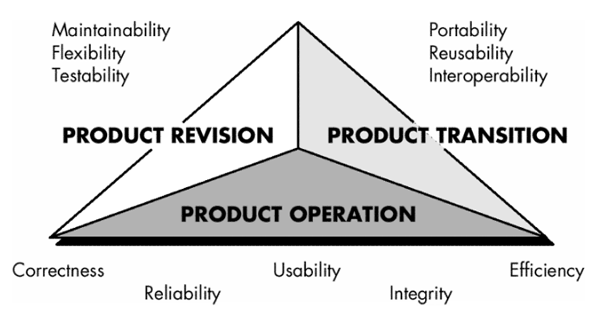
- Correctness - The extent to which a program satisfies its specification and fulfills the customer's mission objectives.
- Reliability - The extent to which a program can be expected to perform its intended function with required precision.
- Efficiency - The amount of computing resources and code required by a program to perform its function.
- Integrity - Extent to which access to software or data by unauthorized persons can be controlled. Usability - Effort required to learn, operate, prepare input, and interpret output of a program.
- Maintainability - Effort required to locate and fix an error in a program.
- Flexibility - Effort required to modify an operational program.
- Testability - Effort required to test a program to ensure that it performs its intended function.
- Portability - Effort required to transfer the program from one hardware and/or software system environment to another.
- Reusability - Extent to which a program [or parts of a program] can be reused in other applications — related to the packaging and scope of the functions that the program performs.
- Interoperability - Effort required to couple one system to another.
McCall's Software Metrics - (Subjective)
- Auditability - The ease with which conformance to standards can be checked.
- Accuracy - The precision of computations and control.
- Communication commonality - The degree to which standard interfaces, protocols, and bandwidth are used.
- Completeness - The degree to which full implementation of required function has been achieved.
- Conciseness - The compactness of the program in terms of lines of code.
- Consistency - The use of uniform design and documentation techniques throughout the software development project.
- Data commonality - The use of standard data structures and types throughout the program.
- Error tolerance - The damage that occurs when the program encounters an error.
- Execution efficiency - The run-time performance of a program.
- Expandability - The degree to which architectural, data, or procedural design can be extended.
- Generality - The breadth of potential application of program components.
- Hardware independence - The degree to which the software is decoupled from the hardware on which it operates.
- Instrumentation - The degree to which the program monitors its own operation and identifies errors that do occur.
- Modularity - The functional independence (Chapter 13) of program components.
- Operability - The ease of operation of a program.
- Security - The availability of mechanisms that control or protect programs and data.
- Self-documentation - The degree to which the source code provides meaningful documentation.
- Simplicity - The degree to which a program can be understood without difficulty.
- Software system independence - The degree to which the program is independent of nonstandard programming language features, operating system characteristics, and other environmental constraints.
- Traceability - The ability to trace a design representation or actual program component back to requirements.
- Training - The degree to which the software assists in enabling new users to apply the system.
Relationship between quality factors and metrics
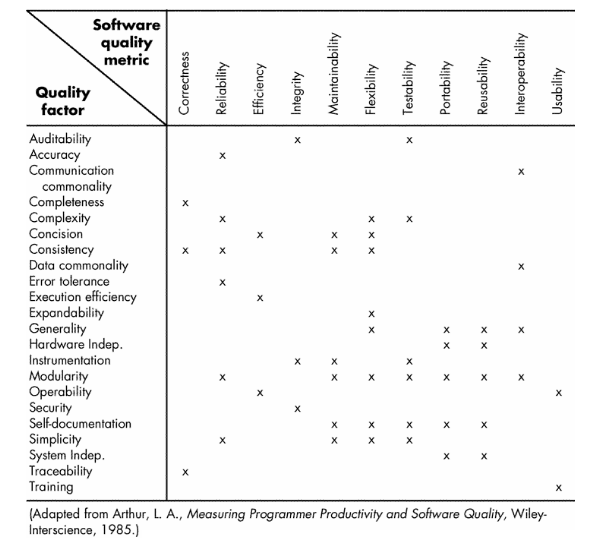
FURPS Quality Factors (Hewlett-Packard)
- Functionality is assessed by evaluating the feature set and capabilities of the program, the generality of the functions that are delivered, and the security of the overall system.
- Usability is assessed by considering human factors, overall aesthetics, consistency, and documentation.
- Reliability is evaluated by measuring the frequency and severity of failure, the accuracy of output results, the mean-time-to-failure (MTTF), the ability to recover from failure, and the predictability of the program.
- Performance is measured by processing speed, response time, resource consumption, throughput, and efficiency.
- Supportability combines the ability to extend the program (extensibility), adaptability, serviceability—these three attributes represent a more common term, maintainability—in addition, testability, compatibility, configurability (the ability to organize and control elements of the software configuration), the ease with which a system can be installed, and the ease with which problems can be localized.
ISO 9126 Quality Factors
- Functionality -The degree to which the software satisfies stated needs as indicated by the following subattributes: suitability, accuracy, interoperability, compliance, and security.
- Reliabilit - The amount of time that the software is available for use as indicated by the following subattributes: maturity, fault tolerance, recoverability.
- Usability - The degree to which the software is easy to use as indicated by the following subattributes: understandability, learnability, operability.
- Efficiency - The degree to which the software makes optimal use of system resources as indicated by the following subattributes: time behavior, resource behavior.
- Maintainability - The ease with which repair may be made to the software as indicated by the following subattributes: analyzability, changeability, stability, testability.
- Portability - The ease with which the software can be transposed from one environment to another as indicated by the following subattributes: adaptability, installability, conformance, replaceability.
Measurement Process Activities
- Formulation – derivation of software measures and metrics appropriate for software representation being considered
- Collection – mechanism used to accumulate the data used to derive the software metrics
- Analysis – computation of metrics
- Interpretation – evaluation of metrics that results in gaining insight into quality of the work product
- Feedback – recommendations derived from interpretation of the metrics is transmitted to the software development team
Formulation Principles for Technical Metrics
- The objectives of measurement should be established before collecting any data.
- Each metric is defined in an unambiguous manner.
- Metrics should be based on a theory that is valid for the application domain.
- Metrics should be tailored to accommodate specific products and processes.
Software Metric Attributes
- Simple and computable - It should be relatively easy to learn how to derive the metric, and its computation should not demand inordinate effort or time.
- Empirically and intuitively persuasive - The metric should satisfy the engineer's intuitive notions about the product attribute under consideration (e.g., a metric that measures module cohesion should increase in value as the level of cohesion increases).
- Consistent and objective - The metric should always yield results that are unambiguous. An independent third party should be able to derive the same metric value using the same information about the software.
- Consistent in its use of units and dimensions - The mathematical computation of the metric should use measures that do not lead to bizarre combinations of units. For example, multiplying people on the project teams by programming language variables in the program results in a suspicious mix of units that are not intuitively persuasive.
- Programming language independent - Metrics should be based on the analysis model, the design model, or the structure of the program itself. They should not be dependent on the vagaries of programming language syntax or semantics.
- An effective mechanism for high-quality feedback - That is, the metric should provide a software engineer with information that can lead to a higher-quality end product.
Representative Analysis Metrics
- Function-based metrics - predict the size of a system that will be derived from the analysis model
e.g.
Part of the analysis model for SafeHome software
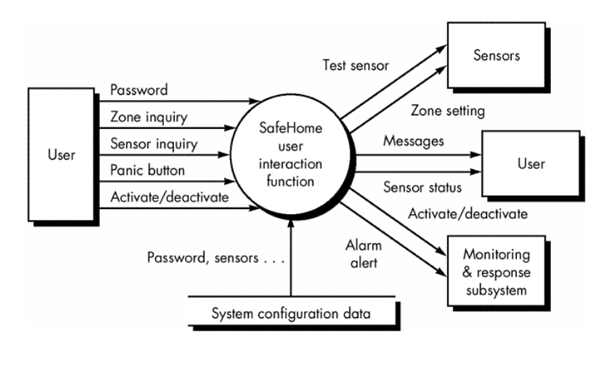
- Data flow diagram evaluated to determine the key measures required for computation of the function point metric
- number of user inputs - password, panic button, and activate/deactivate
- number of user outputs - messages and sensor status
- number of user inquiries - zone inquiry and sensor inquiry
- number of files - system configuration file
- number of external interfaces - test sensor, zone setting, activate/deactivate, and alarm alert
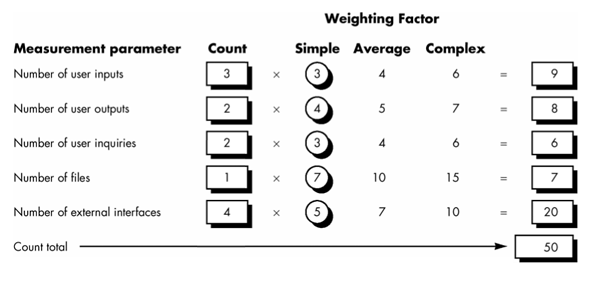
- Count total shown must be adjusted using Function Point (FP):
FP = count total x [0.65 + 0.01 x S (Fi)]
where count total is the sum of all FP entries and Fi (i = 1 to 14) are "complexity adjustment values." For the purposes of this example, we assume that S (Fi) is 46 (a moderately complex product).
FP = 50 x [0.65 + (0.01 x 46)] = 56
- Project team can estimate the overall implemented size of the SafeHome user interaction function.
- Assume:
- Past data indicates that one FP translates into 60 lines of code (an object-oriented language is to be used)
- 12 FPs are produced for each person-month of effort.
- Assume:
- Past projects have found an average of three errors per function point during analysis design reviews
- Four errors per function point during unit and integration testing.
- These data can help software engineers assess the completeness of their review and testing activities.
- Bang metric (Tom DeMarco) - used to develop an indication of the size of the software to be implemented as a consequence of the analysis model
- Computed by evaluating a set of primitives—elements of the analysis model that are not further subdivided at the analysis level
- Functional primitives (FuP) - The number of transformations (bubbles) that appear at the lowest level of a data flow diagram
- Data elements (DE) - The number of attributes of a data object, data elements are not composite data and appear within the data dictionary
- Objects (OB) - The number of data objects
- Relationships (RE) - The number of connections between data objects
- States (ST) - The number of user observable states in the state transition diagram
- Transitions (TR) - The number of state transitions in the state transition diagram
- Additional counts
- Modified manual function primitives (FuPM). Functions that lie outside the system boundary but must be modified to accommodate the new system.
- Input data elements (DEI). Those data elements that are input to the system.
- Output data elements (DEO). Those data elements that are output from the system.
- Retained data elements (DER). Those data elements that are retained (stored) by the system.
- Data tokens (TCi). The data tokens (data items that are not subdivided within a functional primitive) that exist at the boundary of the ith functional primitive (evaluated for each primitive).
- Relationship connections (REi). The relationships that connect the ith object in the data model to other objects.
- Software Classification:
- function strong - emphasize the transformation of data and do not generally have complex data structures
- data strong - tend to have complex data models
RE/FuP
< 0.7 implies a function-strong application
0.8 < RE/FuP < 1.4 implies a hybrid
application
RE/FuP > 1.5 implies a data-strong
application
- Specification Quality Metrics (Davis)
- Characteristics that can be used to assess the quality of the analysis model and the corresponding requirements specification
- specificity (lack of ambiguity)
- completeness
- correctness
- understandability
- verifiability
- internal and external consistency
- achievability
- concision
- traceability
- modifiability
- precision
- reusability
Representative Design Metrics
- Architectural design metrics
- Focus on characteristics of the program architecture with emphasis on the architectural structure and the effectiveness of modules
- Black box - do not require any knowledge of the inner workings of a particular software component
- Structural complexity
- Based on module fanout - the number of modules immediately subordinate to module i; that is, the number of modules that are directly invoked by module i.
S(i) = f 2out (i)
- Data complexity
- Based on module interface inputs and outputs
- Indication of the complexity in the internal interface for a module i
D(i) = v(i) / [ fout (i) ]
where v(i) is the number of input and output variables that are passed to and from module i
- System complexity
- Sum of structural and data complexity
C(i) = S(i) + D(i)
- Morphology (Shape)
- Number of nodes and arcs in program graph
- Different program architectures to be compared using a set of straightforward dimensions
size = n + a
where n is the number of nodes and a is the number of arcs
- e.g. For the following architecture
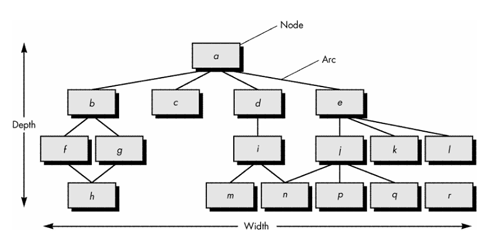
size = 17 + 18 = 35
depth = the longest path from the root (top) node to a leaf node
For above - depth = 4.
width = maximum number of nodes at any one level of the architecture
For above - width = 6.
arc-to-node ratio, r = a/n, measures connectivity density of the architecture
For above - r = 18/17 = 1.06
- Design structure quality index (DSQI) - (US Air Force)
- Information from data and architectural design to derive a design structure quality index (DSQI) that ranges from 0 to 1
s1 = the total number of modules defined in the program
architecture.
s2 = the number of modules whose correct function depends
on the source of data input or that produce data to be used elsewhere (in
general, control modules, among others, would not be counted as part of ).
s3 = the number of modules whose correct function
depends on prior processing.
s4 = the number of database items (includes data objects
and all attributes that define objects).
s5 = the total number of unique database items.
s6 = the number of database segments (different records or
individual objects).
s7 = the number of modules with a single entry and exit
(exception processing is not considered to be a multiple exit).
- Once values s1 through s7 are determined for a computer program, the following intermediate values can be computed:
Program structure: D1, where D1 is defined as follows:
- If the architectural design was developed using a distinct method (e.g., data flow-oriented design or object-oriented design), then D1 = 1, otherwise D1 = 0.
Module independence: D2 = 1 - (s2/s1)
Modules not dependent on prior processing: D3 = 1 - (s3/s1)
Database size: D4 = 1 - (s5/s4)
Database compartmentalization: D5 = 1 - (s6/s4)
Module entrance/exit characteristic: D6 = 1 - (s7/s1)
- With these intermediate values determined, the DSQI is computed in the following manner:
DSQI = SUM(wiDi)
where i = 1 to 6, wi is the relative weighting of the importance of each of the intermediate values, and S wi = 1 (if all Di are weighted equally, then wi = 0.167).
- Value of DSQI for past designs can be determined and compared to a design that is currently under development.
- If the DSQI is significantly lower than average, further design work and review are indicated.
- If major changes are to be made to an existing design, the effect of those changes on DSQI can be calculated.
- Component-level design metrics
- Focus on internal characteristics of a software component and include measures of module cohesion, coupling, and complexity
- Cohesion metrics -
- measure cohesiveness of a module
- Data slice - A data slice is a backward walk through a module that looks for data values that affect the module location at which the walk began.
- Data tokens - Variables defined for a module can be defined as data tokens
- Glue tokens - Set of data tokens that lies on one or more data slice.
- Superglue tokens - Data tokens common to every data slice in a module.
- Stickiness - Relative stickiness of a glue token is directly proportional to the number of data slices that it binds.
- cohesion metrics range in value between 0 and 1
- Value of 0 : zero weak functional cohesion and zero adhesiveness
- when a procedure has more than one output and exhibits none of the cohesion attribute indicated by a particular metric
- procedure with no superglue tokens, no tokens that are common to all data slices - no data tokens that contribute to all outputs
- Value of 1 : strong functional cohesion and adhesiveness
- Coupling metrics -
- An indication of the "connectedness" of a module to other modules, global data, and the outside environment
- Computation -
- For data and control flow coupling,
di = number of input
data parameters
ci = number of input
control parameters
do = number of output
data parameters
co = number of output
control parameters
- For global coupling,
gd = number of global
variables used as data
gc = number of global
variables used as control
- For environmental coupling,
w = number of modules called
(fan-out)
r = number of modules calling the
module under consideration (fan-in)
- Using these measures, a module coupling indicator, mc, is defined in the following way:
mc = k/M
where k = 1, a proportionality constant and
M = di + (a x ci) + do + (b x co) + gd + (c x gc) + w + r
where a = b = c = 2
- Higher the value of mc, the lower the overall module coupling.
- e.g. if a module has single input and output data parameters, accesses no global data, and is called by a single module,
mc = 1/(1 + 0 + 1+ 0 + 0 + + 0 + 1 + 0) = 1/3 = 0.33
- Module exhibits low coupling - mc = 0.33 implies low coupling
- e.g. if a module has five input and five output data parameters, an equal number of control parameters, accesses ten items of global data, has a fan-in of 3 and a fan-out of 4,
mc = 1/[5 + (2 x 5) + 5 + (2 x 5) + 10 + 0 + 3 + 4] = 0.02
- implied coupling would be high.
- Revise coupling metric so it moves upward as the degree of coupling increases
C = 1 - mc
where the degree of coupling increases nonlinearly between a minimum value in the range 0.66 to a maximum value that approaches 1.0.
- Complexity metrics (e.g. cyclomatic complexity)
- Complexity metrics can be used to predict critical information about reliability and maintainability of software systems from automatic analysis of source code [or procedural design information].
- Complexity metrics provide feedback during the software project to help control the [design activity].
- During testing and maintenance, they provide detailed information about software modules to help pinpoint areas of potential instability.
- Most widely used complexity metric for computer software is cyclomatic complexity, developed by Thomas McCabe
- quantitative measure of testing difficulty and an indication of ultimate reliability
- Experimental studies - distinct relationships between the McCabe metric and
- the number of errors existing in source code
- time required to find and correct such errors
- May be used to provide a quantitative indication of maximum module size
- Data from programming projects - cyclomatic complexity = 10
- Appears to be a practical upper limit for module size
- When the cyclomatic complexity exceeded this number, it became extremely difficult to adequately test a module
- Interface design metrics (e.g. layout appropriateness)
- layout appropriateness (LA) is a worthwhile design metric for human/computer interfaces
- GUI uses layout entities—graphic icons, text, menus, windows to assist in completing tasks
- For a specific layout a cost can be assigned to each sequence of actions according to the following relationship:
cost = Sum[frequency of transition(k) x cost of transition(k)]
- where k is a specific transition from one layout entity to the next as a specific task is accomplished.
- Summation occurs across all transitions for a particular task or set of tasks required to accomplish some application function.
- Cost may be characterized in terms of time, processing delay, or any other reasonable value, such as the distance that a mouse must travel between layout entities.
- Layout appropriateness is defined as
LA = 100 x [ (cost of LA - optimal layout)/(cost of proposed layout)]
where LA = 100 for an optimal layout.
- To compute the optimal layout for a GUI:
- interface real estate (the area of the screen) is divided into a grid
- Each square of the grid represents a possible position for a layout entity
- For a grid with N possible positions and K different layout entities to place, the number of possible layouts is
number of possible layouts = [N!/(K! x (N - K)!] x K!
Source Code Metrics - Halstead's Software Science
- Assigns quantitative laws to the development of computer software, using a set of primitive measures that may be derived after code is generated or estimated once design is complete
- n1 = the number of distinct operators that appear in a program.
n2 = the number of distinct operands that appear in a
program.
N1 = the total number of operator occurrences.
N2 = the total number of operand occurrences
- Uses these primitive measures to develop expressions for
- Overall program length
- Potential minimum algorithm volume
- Actual algorithm volume (number of bits used to specify program)
- Program level (software complexity)
- Language level (constant for given language)
- Length N can be estimated
N = n1 log2 n1 + n2 log2 n2
- Program volume may be defined
V = log2 ( n1 + n2 )
- V varies with programming language and represents the volume of information (in bits) required to specify a program
- Minimum volume must exist for a particular algorithm
- Volume ratio L: the ratio of volume of the most compact form of a program to the volume of the actual program
L = 2/n1 x n2 /N2
Testing Metrics
- Metrics that predict the likely number of tests required during various testing phases
- Can use Halstead measure
- Metrics that focus on test coverage for a given component
Maintenance Metrics
- Software Maturity Index (IEEE Standard 982.1-1988)
- provides an indication of the stability of a software product (based on changes that occur for each release of the product).
- Computes the following:
MT = the number of modules in the current
release
Fc = the number of modules in the current
release that have been changed
Fa = the number of modules in the current
release that have been added
Fd = the number of modules from the preceding
release that were deleted in the current release
- Software maturity index is computed as:
SMI = [MT - (Fa + Fc + Fd)] / MT
- As SMI approaches 1.0 as product begins to stabilize