Simulated Annealing
In the example on the previous page, each run of local search has a reasonable chance of
finding the global optimum. This isn't always true. As the problem size grows, the
ratio of bad to good local optima often increases, sometimes to the point of being
exponentially large. In such cases, simply repeating the local search a few times is ineffective.
A different avenue of attack is to occasionally allow moves that actually increase the
cost, in the hope that they will pull the search out of dead ends. The method of simulated
annealing redefines the local search by introducing the notion of a temperature T.
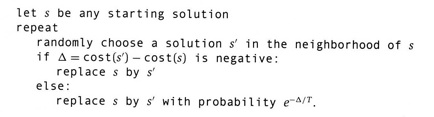 If T is zero, this is identical to our previous local search. But if T is large, then
moves that increase the cost are occasionally accepted. What value of T should be
used?
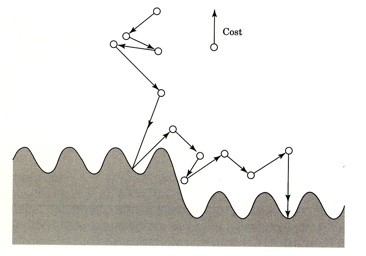
The trick is to start with T large and then gradually reduce it to zero. Thus initially,
the local search can wander around quite freely, with only a mild preference for low-cost
solutions. As time goes on, this preference becomes stronger, and the system
mostly sticks to the lower-cost region of the search space, with occasional excursions
out of it to escape local optima. Eventually, when the temperature drops further,
the system converges on a solution. The figure below shows this process schematically.
Simulated annealing is inspired by the physics of crystallization. When a substance
is to be crystallized, it starts in liquid state, with its particles in relatively
unconstrained motion. Then it is slowly cooled, and as this happens, the particles gradually
settle into their crystal lattice.
If T is zero, this is identical to our previous local search. But if T is large, then
moves that increase the cost are occasionally accepted. What value of T should be
used?
The trick is to start with T large and then gradually reduce it to zero. Thus initially,
the local search can wander around quite freely, with only a mild preference for low-cost
solutions. As time goes on, this preference becomes stronger, and the system
mostly sticks to the lower-cost region of the search space, with occasional excursions
out of it to escape local optima. Eventually, when the temperature drops further,
the system converges on a solution. The figure below shows this process schematically.
Simulated annealing is inspired by the physics of crystallization. When a substance
is to be crystallized, it starts in liquid state, with its particles in relatively
unconstrained motion. Then it is slowly cooled, and as this happens, the particles gradually
settle into their crystal lattice.