Randomization and Restarts in Graph Partitioning
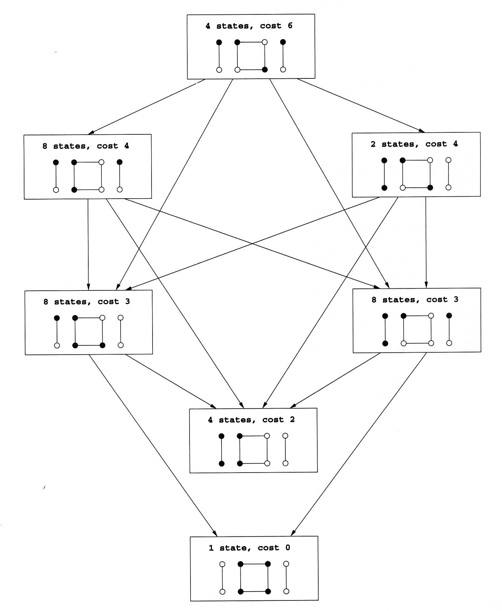
The figure below shows a small instance of graph partitioning, along with the search space
of solutions. There are a total of 70 possible states, but since each of them has
an identical twin in which the left and right sides of the cut are flipped, in effect
there are just 35 solutions. In the figure, these are organized into seven groups for
readability. There are five local optima, of which four are bad, with cost 2, and one
is good, with cost 0. If local search is started at a random solution, and at each step
a random neighbor of lower cost is selected, then the search is at most four times
as likely to wind up in a bad solution than a good one. Thus only a small handful
of repetitions is needed.