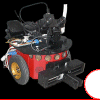
ADAPT is a robotic cognitive architecture, based on the
RS language developed by Damian Lyons of Fordham University. RS is a language
for programming concurrent, distributed sensory-motor schemas, and provides the
high-level abstractions for ADAPT. The cognitive substrate of ADAPT is the Soar
cognitive architecture.
The ADAPT project has been funded by the National Science
Foundation and the Department of Energy, and is a collaboration among Prof. Benjamin
of Pace University, Prof. Damian Lyons of Fordham University and Prof. Deryle Lonsdale
of Brigham Young University.
Here are some papers on ADAPT.
 Check out some video clips.
We are integrating Soar with
PhysX, which is the basis
for the robot's internal world model. PhysX gives the robot
a dynamic world model with sophisticated 3D graphics and a physics
engine.
We are applying multiscale methods to detect anomalous
behaviors in networks. This research project addresses the need for new analytical methods
in cybersecurity. We are investigating the application of modern methods of nonlinear
analysis from the behavioral sciences to analyze attackers' behavior as a complex
behavioral system. This project is funded by the Army Research Office.
We have previously developed VMSoar, which is an autonomous agent for
network security analysis, which monitors a network and learns to project its
future behavior.
Here is an overview paper on VMSoar.
We have collaborated with BBN Technologies in a DARPA-funded project
to develop an intelligent agent to
defend against internal cybersecurity threats.
Here is an overview paper on the BBN project.
Abe Guerra has built an assistant
for IBM's virtual world. His agent uses Soar to reason about what a user
needs and guides the user through the virtual world. The assistant interacts with the user
through typed natural language commands, and can also assist with commands for using the
virtual world interface.
Here is an introductory paper on his project. There is
also a movie of his agent navigating and
a movie of his agent assisting a customer.
Bob Follek has implemented an architecture
for an autonomous poker player. His SoarBot
uses Soar
to play poker with the poker server set up by the University of Alberta Computer Poker Research Group.
Bob can be reached at bob@codeblitz.com